Chief's Dream of Blastic's Disposal in the Underground Machine Room
One Flew Over the Cuckoo's NestChief's Dream of Blastic's Disposal in the Underground Machine Room is a nightmarish episode in Chief Bromden’s narration that transforms the hospital into an immense industrial system. As the ward seems to descend beneath the building, Bromden witnesses Blastic treated as material to be processed and discarded. The dream’s mechanical horror is followed by the sight of aides carrying Blastic away, covered on a stretcher, so that the imagined disposal and the ward’s actual removal of his body remain disturbingly close.
The Dormitory Descends
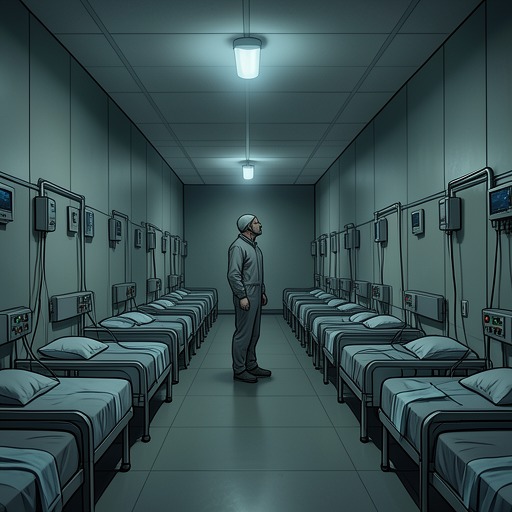
Bromden lies still in the dark, pretending to sleep while listening to the hospital. A signal-like wail comes from the Disturbed Ward, and the devices in the walls gradually fall silent. Beneath that silence, he hears a deep, steady rumble, like the sound at a hydroelectric dam. The change in the hospital’s familiar noise is the first warning that the scene is shifting: ordinary ward machinery seems to give way to a power both larger and less visible.
A black aide appears in the hall, giggling, then reaches into the fuse box beside the dormitory door. When he twists a knob, the dormitory floor begins to descend as a platform, carrying the beds and bedstands with it. The room moves away from its walls, windows, and door, sinking through a square shaft. Its mechanism is eerily quiet; the rumbling grows louder as the light above recedes to a speck and then vanishes. The measured, physical details make the impossible descent feel methodical rather than sudden, as if the ward’s familiar floor were only a movable surface laid over something hidden.
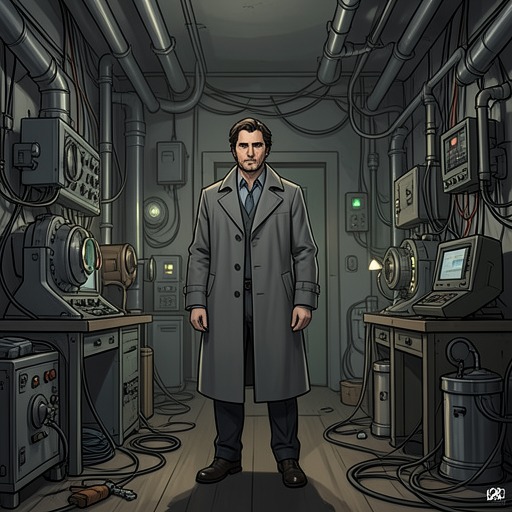
At the bottom, the floor stops and then begins sliding forward. A wall rises to reveal an enormous machine room stretching out of sight. Tubes disappear into darkness, wires run toward unseen transformers, and grease and cinders stain the machinery. Shirtless men move along catwalks and steel steps with smooth, repeated efficiency, turning dials and switches as sparks flash across their faces. Their rhythm is so uniform that Bromden compares it to a pulse. When one worker collapses, two others lift him into a furnace without interrupting their pace. The scene makes human labor itself look absorbed into the machinery it serves.
Blastic Is Taken Apart
The dormitory floor enters the machine room beneath a trestle fitted with rollers. Above the beds, two men in white shirts, turned-back sleeves, and thin black ties confer with cigarettes in long holders. Their words cannot be heard over the roar. One snaps his fingers, and a worker immediately turns toward him; a gesture and a pointed cigarette holder are enough to direct the worker to a particular bed. The scene gives authority a distant, supervisory position, while the worker carries out its commands below.
The worker returns with a hook and moves along the overhead track until he reaches Blastic’s bed. Bromden recognizes the worker’s face as handsome but brutal and expressionless. The worker lifts Blastic by the heel and drives the hook through the tendon behind it, leaving the old man suspended upside down. Blastic flails his arms and free leg, and his pajama top slips over his head. The worker gathers the fabric around him like a sack and pulls the trolley along the trestle toward the men above.
One supervisor lowers a scalpel attached to a chain. The chain is looped around the railing, preventing the worker from running away with the instrument. That detail extends the scene’s logic of control: even the person carrying out the violence is restrained and managed. The worker slices open Blastic, who stops thrashing. Bromden expects to see blood and organs, but the body releases rust and ashes, with pieces of wire and glass among them. The dream does not present Blastic as an ordinary corpse so much as an object made of the hospital’s industrial residue. Its grotesque image gives bodily form to Bromden’s perception of people being reduced to parts within a system.
Waking into the Ward
Bromden considers waking McMurphy, Harding, and the other patients, but imagines that they would dismiss him as a fool or help the workers put him on a hook. His inability to make the others believe him leaves him isolated inside the vision. As the fog thickens, other horrors become indistinct. He anticipates being pulled back to the ward and finding no visible trace of what he has seen; any attempt to explain it, he expects, would be treated as a report of an impossible nightmare.
Turkle does pull him out of the fog. The night aide shakes Bromden and recognizes that he has been having a bad dream. Turkle works the long shift from eleven at night until seven in the morning, and Bromden notices that he smells as though he has been drinking. On some nights Turkle loosens a sheet tied too tightly around Bromden, taking care to avoid the day crew’s notice. This time, however, he leaves the sheet in place and goes to help two unfamiliar aides and a young doctor lift Blastic onto a stretcher. They cover the old man and carry him out, handling him more carefully than anyone had handled him during his life.
The Dream’s Horror and Its Aftermath
The episode keeps two kinds of knowledge in uneasy contact. The machine room is presented through Bromden’s dreamlike vision, and Turkle identifies the experience as a bad dream; the scene does not establish that an actual underground room exists. Yet the dream’s central image is followed by a concrete event on the ward: Blastic is removed on a stretcher. The aides’ unusual care does not confirm the imagined dissection, but it makes the waking world no simple release from the vision. The body Bromden saw processed in a furnace-like world is also the body the ward’s staff now carry away.
The descent, the silent machinery, and the workers’ coordinated disposal of a fellow human being turn Bromden’s fear of hidden institutional power into an elaborate nightmare. Its horror builds through delayed revelation: first an unfamiliar rumble beneath the hospital, then a floor moving through darkness, then the vast room and the treatment of Blastic. The final return to the ward does not resolve the image so much as place it beside Blastic’s removal. By bringing dream and aftermath together without making them identical, the episode preserves the force of Bromden’s perception while leaving the machinery’s literal existence uncertain.